

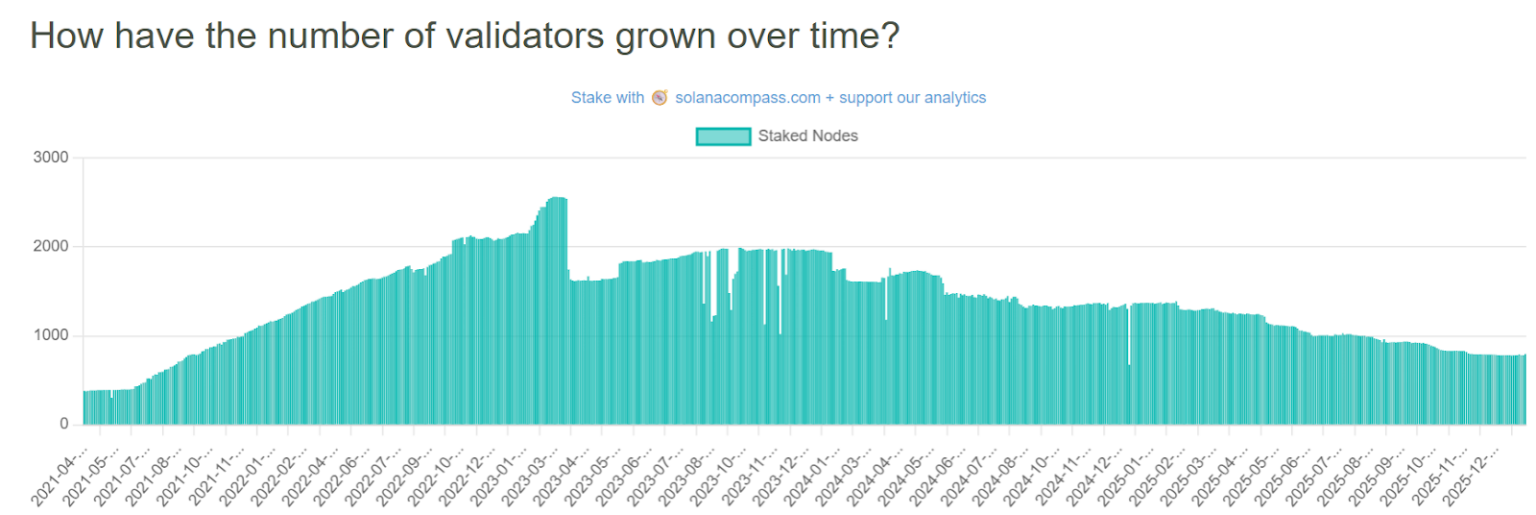
- Solana’s lively validator depend has plummeted 68%, dropping from over 2,500 in 2023 to roughly 795 in early 2026.
- Smaller operators are being priced out by intense competitors from zero-fee institutional validators and annual voting prices that now exceed $49,000.
- Community decentralisation is weakening, as evidenced by the Nakamoto Coefficient falling from 31 to twenty, signaling that management is concentrating amongst fewer large-scale entities.
Solana’s validator community is shrinking quick attributable to financial causes.
In response to data from Solana Compass, the variety of lively validators has fallen from about 2,560 in early 2023 to roughly 795 in the present day, a 68% drop. Validators are the machines that vote on blocks and preserve the chain operating. Fewer validators means fewer unbiased actors securing the community.
A few of this decline is innocent cleanup of inactive nodes. However operators say the actual drawback is that operating a validator not pays for smaller gamers.
Learn extra: Solana Mobile Launches SKR Token Airdrop for Seeker Smartphone Users
Low Charges Make Operations Much less Viable
As an illustration, Moo, an unbiased Solana validator, said giant validators now cost 0% charges to draw stake, leaving little income for independents. When rewards fall beneath prices, smaller validators shut down.
it’s turning into more and more unimaginable to function a validator profitably (…) Many small validators are actively contemplating shutting down. Not attributable to lack of perception in Solana, however as a result of the economics not work. At this level, the one justification left is altruism. Loving the community and caring about decentralization isn’t a sustainable enterprise mannequin.
That strain additionally exhibits up clearly in decentralisation metrics, because the Solana Nakamoto Coefficient, or the minimal variety of unbiased entities wanted to manage a essential share of the community, has dropped from 31 to twenty. In easier phrases, management over Solana’s stake is turning into extra concentrated in fewer palms.
The fee construction goes one thing like this:
- A validator should stake SOL and constantly ship vote transactions to take part in consensus.
- Voting alone can value as much as about 1.1 SOL per day. Over a yr, that provides as much as roughly 401 SOL simply to remain on-line.
- At present costs, the first-year requirement excluding {hardware} and servers is round US$49,000 (AU$75,000). For a lot of small operators, that math doesn’t work anymore.
This doesn’t imply Solana is failing or insecure in the present day. Massive validators are skilled, well-capitalised, and technically succesful, however it does imply decentralisation is drifting towards establishments and enormous staking suppliers fairly than people.
Associated: Analyst: Gold’s Surge Signals a Trust Crisis – and Crypto’s Moment
The submit Solana Validator Count Drops 70%, Fueling Decentralisation Concerns appeared first on Crypto News Australia.